Summer is here with a vengeance and fierce fires have been roaring through parts of the Adelaide hills. We are hoping for a change in the weather and for some rain especially in the hills so as to give the Firies a break and for people to be able to go back to their properties and deal with the damage they will find. Luckily so far no lives have been lost but a lot of stock and pets have died or had to be put down because they were too badly burnt.
Meanwhile we have been fortunate enough to be able to be in the cool inside.....
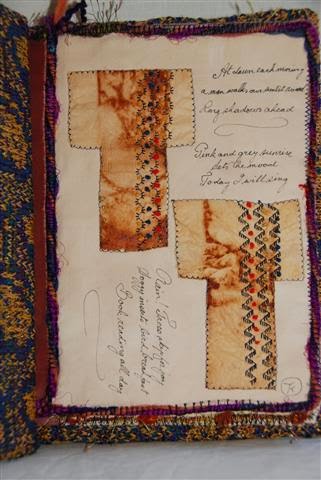
My latest effort in making books has given me interesting challenges.I started off using the recycled tea bags which seem to collect and sit around getting that lovely antique patina on them.
Started with cutting some up and found this rather interesting shape of Kimonos. Then decided to applique them onto the already tea dyed cotton sheeting which is also being recycled...
( Oh dear, does that sound rather virtuous ?)
There are very interesting stitches on my Bernina sewing machine which I have had great pleasure in exploring and find
that repeating the same stitch gives great opportunities for further decoration with the Colonial knot.
Colonial knots are my passion at the moment because you can do them sitting in front of TV or any spare moment you might have and they save you from being bored....
Because I seem to have run out of old denim, the other option to back the signatures was using the rose pink velvet.
Someone gave me a whole roll of this material and so it is a good way to use it up.
Velvet is not an easy fabric to deal with as the pile is inclined to want to do its own thing and does not like to be on top of itself.
So putting the flanges together to bind them into a book form
they will move about and it was quite tricky to keep them level
and together.
The other challenge was to edge each page with cording or an interesting fancy yarn with fibers and bits of chenille with a cording foot that came with the machine. In the end it worked a treat......
The little Haikus were not true Haikus to start with, well, written in English they are really just little bits of poetry trying to imitate
the lovely Japanese form ....
To begin with I got the sequence wrong, thinking it was five syllables, then three and then five again.....then I found out they consist of seventeen syllables organized as five, seven, five
and mostly to do with nature....
you may be able to read some of them by clicking on the photos...
Below is a photo of three rainbow lorikeets which were sitting on the birdbath this morning looking like a group of little old men wondering where the water had gone, I dutifully filled it up for them as the day was a scorcher so early in the morning.......
Tuesday, 6 January 2015
Wednesday, 24 December 2014
The Facinating Flinders Ranges
What am I doing organizing this on Christmas
Eve.....not a care in the world have I...
Yet it bothers me that I have created this textile fibre book about the Flinders Ranges and want to convey how fascinating these ancient , eroded
and strikingly beautiful mountains are...
how they were invaded by a people two centuries ago, who were frankly not the least bit interested in the people who were already making a living there without destroying their habitat.
Yet the intrepid white people, with a philosophy
of needing to settle the land and make it productive, did an amazing job of exploring and
recording what they found.
Their attitudes two centuries ago were so different to our present day of being aware of the delicate country side they were in. Of the delicate balance that keeps the ancient Australian eco systems from being destroyed....
The Ediacara ranges have revealed the most ancient and unusual fossils dating back to the pre Cambrian times....
In lake Callabonna in 1892, Fred Ragless found an amazing amount of scattered skeleton bones which proved to be a Diprotodon , the largest of the Marsupials and was mounted as a complete skeleton in the South Australian museum.
The Flinders Ranges were also explored for copper but none of the mines ever produced a great deal of copper and the arduous trek by bullock wagons didn't make it a worth while effort and so most of the mines which may have been started could not go on.
Still, the Flinders has the most poetic of name places ,Angorichina.. Wirrealpa..Umberatina..
Ical Icala..Moolooloo..Oratunga..Witchelina..
Wertaloona..Oraparinna..Hollowiliena..
Ediacara...
Here is my Christmas gift to you...I hope you will enjoy the spirit of it all.....
Thursday, 4 December 2014
Textile/Fibre Artist book on Words
Words... We all use them, write them,
speak them, whisper them, shout them,
draw them, think them, imagine them,
invent them, organize them, forget them
dream them and wonder who on earth started them...... at least I do, wonder who was the first person to say something in words rather than
grunts
and who was the first person to draw a picture to represent a detail of the surroundings and objects they lived with...
What were the earliest hieroglyphs ever used?
A little bit of research on the web and you are inundated with information about the history
of the alphabet and how it can be linked back
to before the end of the 4th millennium BCE.
The Mesopotamian cuneiform and Egyptian
hieroglyphs.
By 2700 BC the Egyptians had developed the
hieroglyphic writing system. The logogram
represents a word denoting an object pictorially
depicted by a hieroglyph.
The phonogram represent the sound of a word.
The thing is though, that human kind drew images of the animals they were hunting on rock walls in caves before they could write. It was their way of letting others know that hunting was good in this area.
I was intrigued to find that the oldest rock art is in India at the Auditorium cave and this is very similar to the Acheulian rock art in the Kalahari desert in South Africa.
Our indigenous Australian aboriginal rock art is a little later at approximately 25 to 30 thousand years old.
I was given a book years ago, on the Lascaux Cave paintings which has wonderfully lively paintings of bulls and other animals which go back to the Palaeolithic era when Homo Sapiens was living and hunting in these areas of France.
It is fascinating to think how writing evolved from these early depictions.
The subject is really too huge to condense into a few sentences here and I am in no way qualified to do so anyway, but it is intriguing all the same.
Remember to click on the photos if you want a closer view. It contains a few sentences written in my mother tongue, relating a few of the sayings with which our parents would quote at times when we needed to think about what we were doing......
The covers are again knitted to fit, in mixed cotton yarns using a fair isle pattern....
Monday, 24 November 2014
November Sunday Soiree
We had a great afternoon last Sunday, playing music for a small gathering of friends and family in our Studio.
The weather wasn't crash hot, well, it was humid and warm at times which is inclined to play havoc with string instruments as they are inclined to go flat...
But we managed and played our pieces with aplomb if not always in tune or in time...the audience was kind ,bless them....
We played "The arrival of the Queen of Sheba"
at a sedate pace as a warm up.
Next we played Bourree by J S Bach in which we left out the repeats as that would have sent the audience to sleep.
Then Three Trios by Haydn which Ken had
re-organized for us so we only played the charming bits.
Bach's Prelude 22 is quite tricky as we all play different parts and the timing needs to be spot on
However we all finished together in the end....
Relief , relief...
After a bit of a breather, my cello teacher Catherine Finnis played the duet part of Willem de Fesch's Sonata op.8 Nr 3 with me as I have been studying this piece for quite a while...bless her, she supported me in all the right places and I managed to complete it without too disastrous a
result. Catherine does a brilliant job in keeping me enthused and motivated....
The highlight of the afternoon though, was Catherine and her husband John Gray playing the only Duet for Cello and Double Bass ever written by Rossini, it was just fabulous . Catherine has played her cello all over the world and John played the double bass in the Academy of St Martin in the Field for many years but he also played in all the film music for the
James Bond series.....how is that for fame.....
but as we know, fame is a fleeting thing and here they are playing in our humble Studio...what an afternoon..... We finished celebrating with a few reds and coffees......and everyone went home happy
Thursday, 30 October 2014
SA Machine Knitting Weekend @ Camp Willochra
| View of the hills from the back of the building |
The Watervale oval has a quaint old fashioned grandstand. In the 60ies we used to go to the CFS fundraisers held on the oval there and buy interesting old fashioned picture frames people had donated to the white elephant stall.
Refreshed, we headed for Melrose which claims to be the oldest town in the Flinders ranges, 1853.
| All set up in the Chapel |
typically Flinders Ranges blue and mysterious in its huge, silent presence. As you enter the town and on a bit, there is a sudden right angled turn in the road which takes you on out of the town towards Wilmington. The majestic old gumtrees on the flood plain line the road towards the Willochra camp site which is a few kilometers out of Melrose and just past the monument for Goyder and his Goyder line. We arrived tonguing for a coffee but unloaded the car first and set up the bedroom which has bunk beds but fortunately there were lower bunks for us. Then set up my Brother 860 and knit leader in the chapel where some of our members were busy starting the projects already. The chapel is quite spacious and we all found a spot that suited us.
| Roma and Sylvia |
The next morning was an early start with our most experienced Passap knitter giving a lecture on the ability of the machine to do wonderful patterns without necessarily having a card device on the machine. Roma said it was her Swansong.
(I have another friend who did her Swansong as an artist by having a SALA exhibition in August)
I am having the most awful trouble with this cursor not doing what I want it to do......... So you are getting a very different blog to what I had intended.
| Wendy, Jill, Brenda, Mary, Mavis |
Wendy demonstrated the making of a glove later in the morning and then Jill talked about her many interesting patterns of gloves, hats and beanies, baby and dolls' garments.
In the afternoon we all got stuck into our projects. Mine started off as a disaster as the cone of yarn I had brought for project 1,was broken yarn, so on with project no2 .
The evening was spent with entertainment one of which was a horse race in which some "volunteer" members painfully stepped heel to toe to the number thrown by dice... not sure which horse won but it wasn't me. Try walking heel to toe and see how tricky that is at our age.....
| Joan reading her last Will and Testament |
I did have a photo of the horse race but somehow it has vanished into the computer sky.......
Remember to click on the photos to get a closer look.....
Thursday, 23 October 2014
Mare Atlanticus.....
My next project has been inspired by Simon Winchester's book" Antlantic". He tackled a huge subject and must have done amazing amounts of research for this.
I enjoy his personable style of writing, none of this "my writing is as a result of Creative Writing courses I have attended".
The book is full of interesting words and interesting ideas and wonderful asides...
It is inspirational to read about, to me, obscure scientific research...Dr Penny Chisholme and her
research colleague Rob Olsen discovered a tiny,oval- shaped living entity in the Sargasso sea which they named Prochlorococcus. There are trillions and trillions of these and they were found to convert carbon dioxide into oxygen. They only live in the warm parts of the Atlantic and drift along to be eaten by the tiny shrimp which are eaten by something bigger and so on, the trouble when you are the bottom of the food chain....
The signatures I created relate to the amazing large creatures that swim about in the Atlantic and the history of the intrepid seafaring ancient peoples
who dared to set forth in their fragile crafts to explore and find new treasures on far away coasts.
The Vikings were an intrepid but marauding lot of men who lived in the northern parts of Europe and visited most countries within the reach of their longships. They raped and pillaged most of the northern European coastlines.
There is actually a connection with my very own family and the Vikings. The Dupuytren's syndrome is known as the Viking's disease and my oldest brother suffered with it. It contracts the sinews
of the hand and causes the fingers to start curling in. My grandmother came from Friesland which is close to Denmark from where the Vikings would launch forth on their raping and pillaging forays , so who knows what went on in the dim, distant past...... The other bit of historical information I gleaned, was the fact that the Dutch navy were the first to adopt a formation of lining their ships up in a naval battle and systematically firing their cannons into the Spanish navy and so defeated them.
Now for something entirely different......
The greenies, a honey eater , had made this beautiful nest in the Pandorea vine last month.
It is beautifully woven and one can only marvel at the architectural creativity at work here. It is lined with delicate little pink Galah feathers and soft grass. They have since built another nest in the patio vine and are busy hatching another lot of babies.
This season the Tawny Frogmouth has hatched two chicks. They do seem to take more than three weeks to hatch. Now though, they are getting quite big and if you click on this photo
you will get a better look at them
It is keeping so dry, we have not had any rain of consequence since August and we are having to water twice a week now
You soon forget how cold it was some weeks ago now we are already experiencing temperatures in the high thirties....
Monday, 13 October 2014
Heteropoda hauntings....
Well, doing some dusting last Friday ( ready for the week-end... in case.....) what should I come across but my little friend the Heteropoda, sitting comfortably on the wall above the front door.
Was it really the same arachnid as the one I photographed in the rain gauge some weeks ago now, or was it a cousin or even a sibling?
Had it followed me into our house, was it trying to tell me something? I left it alone of course, thinking it is quite safe inside.
What should happen this morning though, when I lifted my hat off the table , there in a flurry of legs, frightening the daylight out of me with its sudden movement, was Heteropoda , looking somewhat stiff and undernourished when it stopped to look me in the eye.
I went and got my spider catching glass rectangle
and kept him captive for a while to take more photos of him.
Interestingly, my little Nikon Coolpix took better photos of it than my super duper Nikon 80.
It posed beautifully, standing on its eight legs
looking well.....like a spider. I took it outside afterwards and freed it into the Clivia patch near the Holm oak and hope it will find plenty to eat.
What was also a surprise and joy yesterday was seeing we still have the red water lily flowering in our pond.
I found the white faced heron standing on the pot the other morning gobbling up one of our goldfish. It doesn't matter a great deal as there are still about thirty goldfish left, but it is interesting that the bird will take flight the moment we come into the kitchen but will stay when it knows there is something to eat in the pond.
There is also a white waterlily and it is exquisite and so pristine in its whiteness.
The frogs are not as numerous as other years and that is because the goldfish will find all the frogspawn and gobble it up, so in a way I would be quite happy if the Heron eats all the goldfish......
We have had a very dry Spring and the hay was cut last Saturday which is quite early in the season .We are already watering some of our plants, especially the new roses.
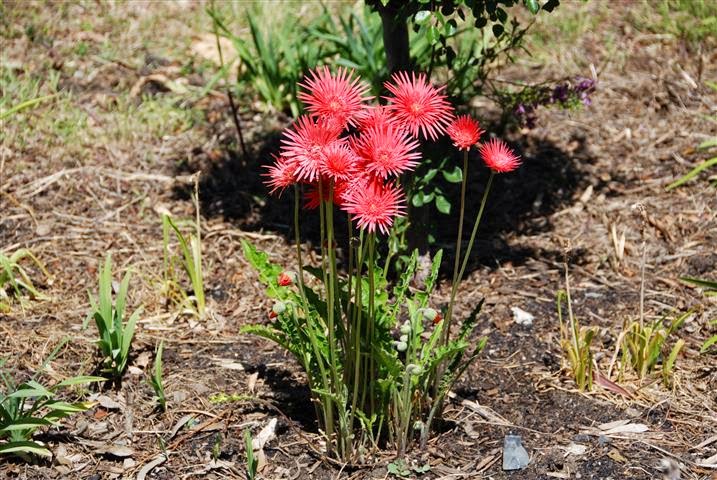
This clump of gerberas is a surprise too, as I thought I had killed them when I sprayed the soursobs which had smothered the clump completely....
The garden is such a pleasure... the Blue tongue lizard yesterday, was able to find shelter in the Kiss-me-quicks by the Studio wall, as the wattlebird was attacking it , not sure why a wattle bird would tackle it, as a lizard does not climb tree.......The Tawny Frogmouth has hatched its young also, two chicks possibly, and the Greenies are building a new nest in the patio vines, this will be their second batch of chicks, the first lot fledged two weeks ago......
Subscribe to:
Posts (Atom)